
Impacts of LC 224/2025 on the Presumed Profit Regime
Impacts of LC 224/2025 on the Presumed Profit Regime: Initial Effects and Judicial Developments
1. Introduction
Brazilian tax legislation underwent a seismic shift with the enactment of Complementary Law No. 224/2025. Through Article 4, the new rule introduced significant changes to the calculation system of IRPJ and CSLL for companies under the Presumed Profit regime, particularly by increasing the presumed profit margins for revenues exceeding the quarterly limit of R$ 1,250,000.00.
This change is not merely an adjustment of rates, but a structural shift that challenges the simplified nature of the regime.
Recently, the Judiciary has begun to be challenged, notably through a preliminary injunction issued by the 1st Federal Court of Resende/RJ (Case No. 5000259-79.2026.4.02.5116), which suspended the increase for a taxpayer, signaling a strong legal defense thesis for the productive sector.
2. The Technical Amendment: The “Margin Surcharge”
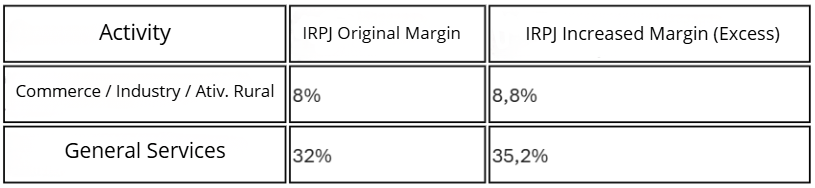
The core of LC 224/2025 lies in Article 4, which establishes a 10% increase on the presumed profit margins applicable to the portion of revenue exceeding the established quarterly cap.
New Presumed Profit Margins (Excess Portion)
According to RFB Normative Instructions No. 2,305/2026 and 2,306/2026, the implementation timeline is distinct:
IRPJ: Effective as of the 1st quarter of 2026.
CSLL: Effective as of the 2nd quarter of 2026 (in compliance with the 90-day rule
3. Calculation Methodology and Proportional Allocation
For companies operating multiple activities (e.g., a sales company that also provides services), the calculation has become more complex. The law requires a proportional allocation of the R$ 1.25 million threshold.
Practical Example of Application
Imagine a company with quarterly gross revenue of R$ 13,000,000, divided between:
Sales Activities: R$ 11,000,000 in quarterly sales
Service Activities: R$ 2,000,000 in services rendered during the quarter
Calculation of the Proportion
Sales Activities (8% margin): 84.61% of total revenue
Service Activities (32% margin): 15.38% of total revenue
Allocation of the Limit (R$ 1,250,000.00)
Limit allocated to Sales:
R$ 1,250,000 × 0.8461 = R$ 1,057,692.31Limit allocated to Services:
R$ 1,250,000 × 0.1538 = R$ 192,307.69
The portion exceeding these individual limits, segregated by activity, will be taxed at the increased presumed profit margins of 8.8% (sales) and 35.2% (services), respectively.
In the case of sales revenue:
R$ 1,057,692.31 will be taxed at the regular presumed margin of 8%;
The remaining R$ 9,942,307.69 will be taxed at the increased margin of 8.8%.
The same applies to service activities:
R$ 192,307.69 will be taxed at the regular presumed margin of 32%;
The remaining R$ 1,807,692.31 will be taxed at the increased margin of 35.2%.
This mechanism increases the tax burden even though there has not necessarily been a corresponding increase in the company’s actual profitability.
4. The Judicial Controversy: Tax Benefit or Calculation Method?
The rationale behind LC 224/2025 is based on the premise that the Presumed Profit regime constitutes a type of “tax benefit.” The Judiciary, however, has begun to reject this thesis.
In a decision issued by the Federal Court of Resende/RJ, the judge emphasized that the Presumed Profit regime is a calculation method, not a waiver of revenue. As an alternative regime, it may even result in a higher tax burden than the Actual Profit regime, which undermines the characterization of a governmental “benefit.”
The decision stated:
“The Presumed Profit regime does not bear the legal nature of a tax benefit or revenue waiver, but rather constitutes an alternative method for calculating the taxable base.”
It further highlighted that:
“Equating the regime to a tax benefit, for purposes of increasing the calculation base, appears legally questionable at a preliminary stage.”
Although this is an interlocutory (preliminary) decision, the reasoning demonstrates the fragility of the central foundation of the legislative amendment.
5. Grounds for Judicial Challenge
Taxpayers have sought judicial relief based on four main pillars:
Qualified Legality: The indirect alteration of the calculation base as a means of increasing tax revenue.
Legal Certainty: The disruption of predictability for companies that planned their fiscal year based on historical margins.
Excessive Complexity: The creation of sub-limits undermines the “simplification” premise that justifies the regime’s existence.
Ability to Pay (Tax Capacity): The risk of a confiscatory effect in sectors with narrow operating margins.
6. Economic Impacts and Strategy
The immediate impact is cash flow compression. Companies with concentrated revenue and actual margins lower than the new presumed margins may end up paying taxes on profits that do not, in fact, exist.
Practical Recommendations:
Scenario Simulation: Compare the Presumed Profit regime (under the new margins) versus the Actual Profit regime for the remainder of 2026.
Preventive Measures: Assess the filing of a Writ of Mandamus to secure the right to calculate and pay taxes under the previous margins.
Operational Control: Adjust ERP systems to implement the proportional allocation required by the RFB.
7. Conclusion
LC 224/2025 undermines part of the attractiveness of the Presumed Profit regime for medium and large businesses. The judicialization of the matter is a natural and necessary path to determine whether the State may unilaterally redefine consolidated accounting concepts under the label of “benefit adjustment.” Monitoring case law throughout this year will be decisive for tax management decisions.